Pre-race anxiety and how to deal with it

I’m in the process of creating a practical guide for runners that can be used as a simple PDF or even a pocket-sized resource. Part I focuses on managing pre-race anxiety, with follow-up sections on handling setbacks during a race and navigating post-race blues. I am taking my inspiration from the SWAP manifesto of- No Secrets!! I hope this helps- Please reach out to me with questions!!!
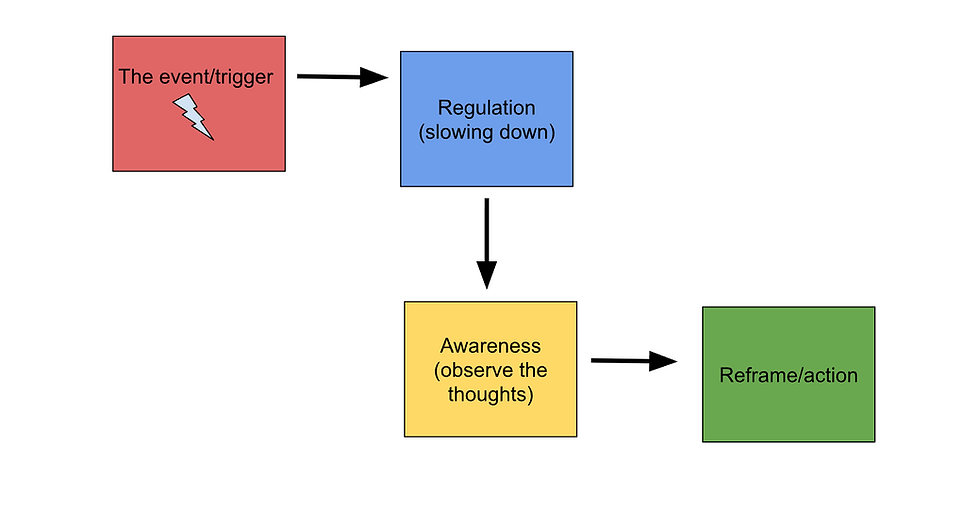
PRE-RACE ANXIETY: A PRACTICAL FRAMEWORK
When we think about pre-race anxiety, it’s important to take a nuanced approach. The why, intensity, and duration of anxiety all vary based on personal history, values, and even genetics. That said, in my experience, there is a framework that we can apply in real-time to help us navigate/triage the situation. The most important principle to remember when the symptoms of anxiety show-up is: slow yourself down. This creates just enough space to understand what’s happening instead of being swept up in it. This takes practice but it has helped so many of my athletes not just get to the starting line but absolutely crush the race altogether. Remember, athletes are resilient- lean into this strength!
THE EVENT (Trigger)
This is the spark- the moment anxiety begins to rise.
At its core, anxiety shows up because you are facing something important with an unknown outcome. That combination…high stakes + uncertainty creates friction. And in endurance sports, that friction is amplified by the expectation of physical discomfort and mental strain. I am going to use a classic example that comes-up with many of my ultra-runners.
Example: A runner steps to the start line and suddenly feels off. Heart racing. Tight chest. A wave of dread. Emotions build quickly… tears, overwhelm, even thoughts of escaping the race altogether. Looking around, runner feels like a fraud and is starting to tell himself that he shouldn't be there to begin with.
THE BELIEF (Where We Intervene)
This is where we have influence… but first, we have to create space. Instead of immediately reacting to the anxiety, we MUST slow things down.
That might look like:
Stepping away to a quieter space (if possible- think back to your car, or in a less crowded part of the race start)
Using a sensory reset: cold water, ice on the neck
Listening to a familiar song
Physical grounding (hugging someone, feeling your feet on the ground)
Temporarily distracting your thoughts with a mindfulness exercise like - look for 5 things that are the color red or 3 people wearing bucket hats. It seems silly, but again the goal is to just slow down the flooding of emotions.
Remember, this isn’t the solution- it’s how you get your footing and begin to push back.
Create Distance from the Thought
Your thoughts are not necessarily facts, and they are not you.
Humans have thousands of thoughts a day, many of them random, intrusive, or even dark. A thought alone does not predict behavior, define your character, or determine your future. Most times the thoughts don’t even register. For example, you might see a tall building and think, “Wow! If someone jumped from the top, they would not survive. Yikes!” And then you move on to the next task or interaction without even thinking about that dark thought. This is normal and it does not mean that this person is suicidal, depressed or “broken” in any way. It is simply the way our human mind registers information.
Sometimes thoughts become “sticky” and feel more powerful…but they are still just thoughts.
The goal is to observe, not absorb.
Back to our runner: Instead of getting pulled into the spiral, they step back and notice:
“I’m feeling really anxious right now. That doesn’t mean anything about how I’ll perform today. This is my body reacting to something that matters to me. I know this feeling will pass. Maybe it’s connected to my last race being really hard. I threw-up a bunch and Skratch will never taste the same.”
ACTION (Reframe + Respond)
Now that there is some distance, we can shift the interpretation. This is where reframing comes in.
We take the same experience and give it a meaning that is:
More accurate
More helpful
Performance-supportive
Then, we ground that reframe in facts. Facts are important because we are not tricking ourselves- rather, we are supporting our self-efficacy (a belief in our capabilities).
For this runner:
“This anxiety is a sign that I care deeply about this. My mind is trying to protect me, but I am prepared. I’ve trained well. My hydration is dialed. I’ve covered these distances before. I’m not alone out there. I’ll be supported throughout the race. I can handle this.”
Anxiety doesn’t mean something is wrong. Often, it means something matters. The goal isn’t to eliminate it…it’s to understand it, work with it, and keep moving forward anyway. It is also a moment in time that will pass. Allow yourself to work it out and do so without judgement or panic. Endurance athletes are some of the strongest people I know--- YOU GOT THIS!


Comments